Table of Contents
The Two AI Giants of 2026
ChatGPT (by OpenAI) and Claude (by Anthropic) are the two most widely used large language models in 2026. OpenAI's GPT-5.2 and Anthropic's Claude Opus 4.6 were released within weeks of each other in early 2026, creating the most intense head-to-head rivalry the AI industry has ever seen.
This isn't a surface-level comparison. We've dug into benchmark scores, real-world coding tests, API pricing per token, context window limits, privacy policies, and community blind tests to give you the data-driven answer to the question everyone's asking: which one should you use?
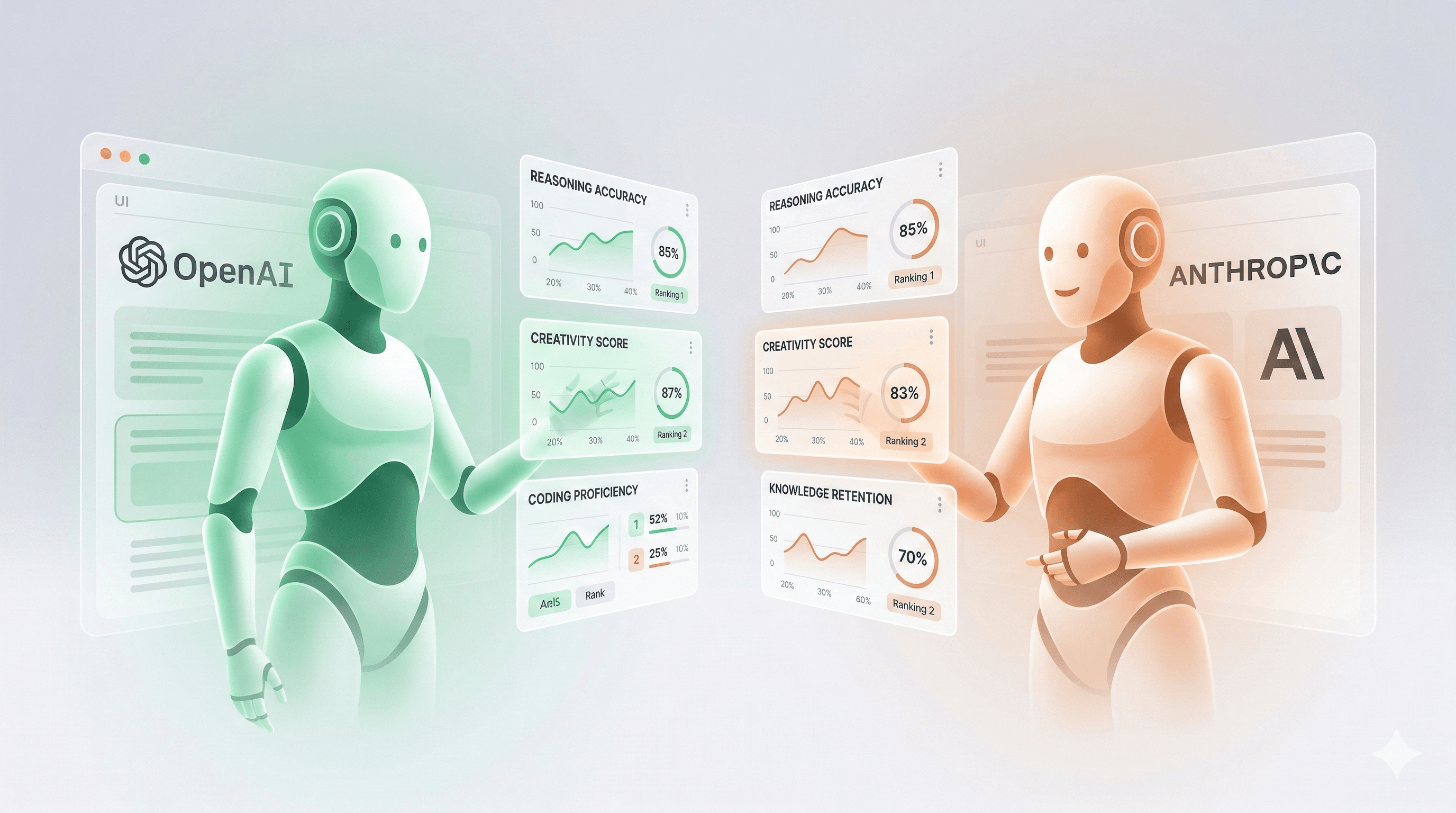
ChatGPT vs Claude — Score Comparison
Benchmark Scores Compared
Here's how the flagship models from each provider stack up on key industry benchmarks as of March 2026:
| Benchmark | GPT-5.2 | Claude Opus 4.6 | Winner |
|---|---|---|---|
| MMLU-Pro | 89.4% | 88.7% | GPT-5.2 |
| HumanEval (coding) | 93.8% | 95.2% | Claude Opus 4.6 |
| SWE-Bench Verified | 74.9% | 72.3% | GPT-5.2 |
| GPQA Diamond | 71.2% | 69.8% | GPT-5.2 |
| ARC-AGI-2 | 31.4% | 33.1% | Claude Opus 4.6 |
| LMArena (blind preference) | 1289 Elo | 1301 Elo | Claude Opus 4.6 |
| GDPval-AA (economic value) | 1180 Elo | 1324 Elo | Claude Opus 4.6 |
Key takeaway: GPT-5.2 leads on traditional academic benchmarks (MMLU, SWE-Bench), while Claude Opus 4.6 leads on preference-based tests and economically valuable tasks. In a community blind test with 134 voters, Claude won half the rounds — more than any other model.
Pricing at a Glance
Pricing: Subscription & API
Both offer a $20/month consumer plan, but the value proposition differs significantly:
| Plan | ChatGPT | Claude |
|---|---|---|
| Free tier | GPT-4.1-mini, limited GPT-5 | Claude 3.5 Sonnet, limited |
| Plus / Pro ($20/mo) | GPT-5.2, DALL-E, browsing, voice | Claude Opus 4.6, extended thinking |
| Team ($25-30/user/mo) | Higher limits, admin console | Higher limits, team sharing |
| Enterprise | Custom, SOC 2 Type II | Custom, SOC 2 Type II |
API pricing (per 1M tokens):
| Model | Input | Output | Cached Input |
|---|---|---|---|
| GPT-5.2 | $1.75 | $14.00 | $0.175 |
| GPT-4.1 | $2.00 | $8.00 | $0.50 |
| GPT-4.1-mini | $0.40 | $1.60 | $0.10 |
| Claude Opus 4.6 | $15.00 | $75.00 | $1.88 |
| Claude Sonnet 4.6 | $3.00 | $15.00 | $0.38 |
| Claude Haiku 3.5 | $0.80 | $4.00 | $0.08 |
Key takeaway: For high-volume API usage, GPT-4.1 is significantly cheaper. But at the consumer subscription level ($20/mo), both offer excellent value — ChatGPT includes image generation (DALL-E), while Claude includes extended thinking for complex reasoning.
Feature Overlap
| Feature | ChatGPT | Claude |
|---|---|---|
| 200K token context window for processing large documents | — | ✓ |
| Artifacts for interactive code, documents, and visualizations | — | ✓ |
| Conversational AI with memory across chats | ✓ | — |
| Custom GPTs for specialized workflows | ✓ | — |
| DALL-E image generation built in | ✓ | — |
| File and image upload for analysis | ✓ | — |
| File upload support for PDFs, code, and images | — | ✓ |
| Projects for organizing conversations with custom instructions | — | ✓ |
| Strong performance on academic and technical writing | — | ✓ |
| Web browsing and real-time information retrieval | ✓ | — |
Context Windows & Long Documents
Context window size determines how much text a model can process in a single conversation:
- GPT-5.2: 400K tokens (~300K words) — the largest of any OpenAI model
- Claude Opus 4.6: 200K tokens (~150K words) — consistent across Claude models
- Claude via API: Up to 1M tokens with prompt caching enabled
GPT-5.2 has the edge on raw context window size, but Claude's 200K is sufficient for most real-world tasks. Where Claude shines is long-context retrieval accuracy — in "needle in a haystack" tests, Claude consistently retrieves information from deep within large documents more reliably than GPT models.
Coding: Head-to-Head
Coding has become the most contested battleground. Claude Opus 4.6 scored 100% (220/220) in one 48-hour coding benchmark, while GPT-5.3 Codex leads on SWE-Bench Pro. Here's the breakdown:
| Metric | ChatGPT (GPT-5.2) | Claude (Opus 4.6) |
|---|---|---|
| HumanEval | 93.8% | 95.2% |
| SWE-Bench Verified | 74.9% | 72.3% |
| Multi-file refactoring | Good | Excellent |
| Code explanation | Very good | Excellent |
| Output speed (tokens/sec) | ~180 | ~65 |
| Extended thinking (complex) | o3/o4-mini | Built-in |
For quick code generation and iteration, ChatGPT is faster (roughly 3x output speed). For complex, multi-step programming challenges requiring deep reasoning, Claude's extended thinking gives it a measurable edge. Many developers report using both: ChatGPT for rapid prototyping and Claude for debugging complex logic.
Privacy & Data Handling
This is one of Claude's clearest advantages:
- Claude: Does not train on user data by default. Constitutional AI framework adds safety constraints. Enterprise plans include data isolation guarantees. Prompt injection resistance rate: 95.3%.
- ChatGPT: Training on user data is opt-out (off by default in Team/Enterprise plans). Requires enterprise tier for guaranteed data isolation. Prompt injection resistance rate: 78.1%.
For regulated industries — healthcare, legal, finance, government — Claude's privacy-first approach is a significant differentiator. Anthropic has positioned itself as the "safety-first" AI company, and the data handling policies reflect that.
Ecosystem & Integrations
ChatGPT wins decisively on ecosystem breadth:
- ChatGPT: 1,000+ GPT Store plugins, DALL-E image generation, voice mode, web browsing, file analysis, Canvas (document editing), native mobile apps, Zapier/Make integrations
- Claude: Projects (persistent context), Artifacts (interactive documents), MCP protocol for tool use, API-first approach, computer use capability, Claude Code (CLI agent)
ChatGPT is the all-in-one platform — everything under one roof. Claude is the specialist's toolkit — fewer features, but each one is deeply polished. Claude Code, in particular, has become a standout — a full autonomous coding agent that crossed $500M annualized run-rate.
Best For: Choosing by Use Case
| Use Case | Best Choice | Why |
|---|---|---|
| Creative writing | Claude | More nuanced, avoids cliches, follows complex instructions |
| Quick coding tasks | ChatGPT | 3x faster output, good enough quality |
| Complex debugging | Claude | Extended thinking mode excels at multi-step reasoning |
| Image generation | ChatGPT | Built-in DALL-E; Claude has no native image gen |
| Long document analysis | Claude | Better retrieval accuracy in long contexts |
| Research & browsing | ChatGPT | Built-in web search and file analysis |
| Privacy-sensitive work | Claude | No data training by default, stronger injection resistance |
| Enterprise deployment | Tie | Both offer SOC 2, SSO, admin controls |
| Casual personal use | ChatGPT | Broader ecosystem, voice mode, plugins |
Our Verdict
There is no single winner — and that's the honest answer. Here's our scoring:
| Category | ChatGPT | Claude |
|---|---|---|
| Raw intelligence | 9/10 | 9/10 |
| Coding ability | 9/10 | 9.5/10 |
| Writing quality | 8/10 | 9/10 |
| Ecosystem & features | 9.5/10 | 7.5/10 |
| Privacy & safety | 7/10 | 9.5/10 |
| API pricing | 9/10 | 7/10 |
| Speed | 9/10 | 7/10 |
| Overall | 8.6/10 | 8.4/10 |
Choose ChatGPT if you want an all-in-one AI platform with the broadest ecosystem, fastest output, and cheapest API. Choose Claude if you prioritize accuracy in complex tasks, work in a privacy-sensitive industry, or rely heavily on long-document analysis and advanced coding.
The best approach for most professionals? Try both with their free tiers, then commit to the one that fits your workflow.